Source-based educational review. Independent technical review pending; this page does not approve an installation.
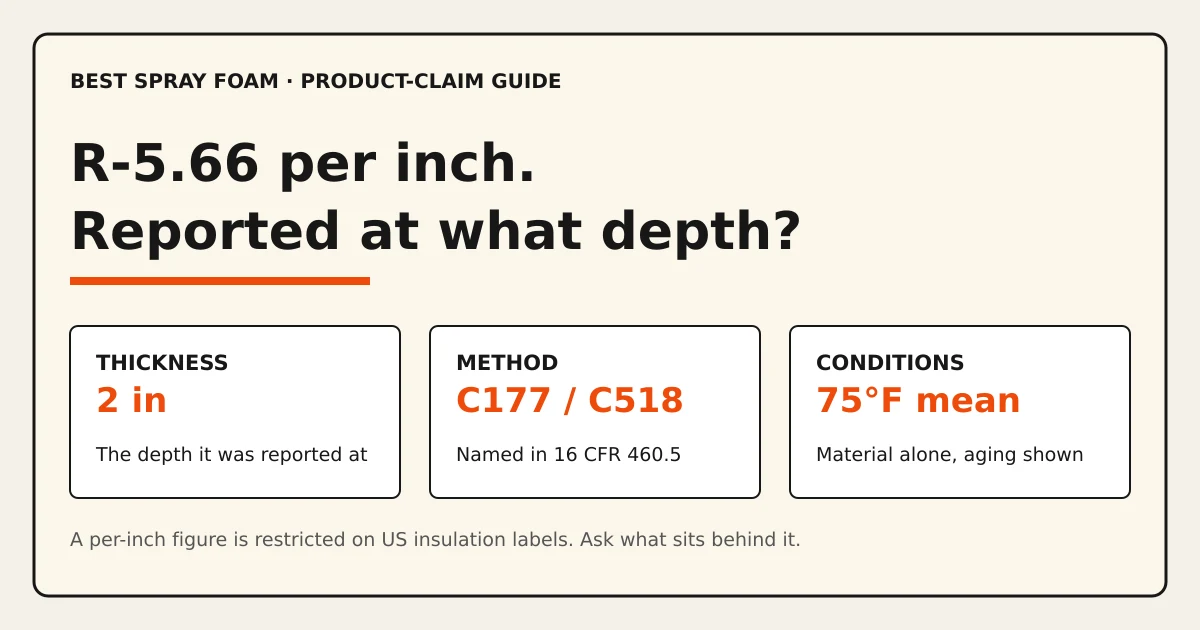
The short version. An R-value means something only with three things attached: the exact product, the thickness it was reported at, and the test it came from. Under US rules an insulation R-value must come from one of four named ASTM tests, run at a 75 F mean temperature on the material alone. A per-inch figure is not allowed on labels or in ads except in two narrow cases. Both canned kits we track publish an R-value per inch based on a superseded German conductivity method. That does not make the number wrong. It means the basis a US buyer would need has not been shown.
What an R-value is, and the test it has to come from
R-value measures resistance to heat flow under stated laboratory conditions. Higher means more resistance. It is not coverage, not air sealing, not durability, and not a property of your wall.
Section 460.5 of the FTC’s R-value Rule is unusually specific about where the number comes from. For insulation other than reflective products, the test must be ASTM C177 (guarded hot plate), ASTM C518 (heat flow meter), ASTM C1363 (hot box) or ASTM C1114 (thin heater). It must be run at a mean temperature of 75 F with a temperature difference of 50 F plus or minus 10 F. It must be run on the insulation alone, excluding any airspace. Results from the two heat-flux methods must be reported only under ASTM C1045.
One clause matters for spray polyurethane in particular. For polyurethane, polyisocyanurate and extruded polystyrene, the rule says the tests must be done on samples that fully reflect the effect of aging on the product’s R-value. Closed-cell foam is gas-filled, and its thermal resistance changes as that gas exchanges with air, which is why ASTM C1303 exists to predict long-term thermal resistance by accelerating that aging in the laboratory.
So a complete R-value claim is not one number. It is a number plus a thickness, a method, a mean temperature, an aging basis and a document you can ask for.
The per-inch rule most listings ignore
Section 460.20 is short and blunt: in labels, fact sheets, ads or other promotional materials, do not give the R-value for one inch or the R-value per inch of your product. There are exactly two exceptions. One covers sellers under an existing FTC cease and desist order, who may petition to amend it. The other is the substantive one.
Under that second exception a seller may give a per-inch figure only where actual test results prove that the R-value per inch of the product does not drop as it gets thicker. Even then the seller may list a range, must say exactly how much the R-value drops with greater thickness, and must add this statement:
“The R-value per inch of this insulation varies with thickness. The thicker the insulation, the lower the R-value per inch.”
That is the reason this site never divides a reported R-value by its thickness, and never multiplies one to reach another depth. Doing so would manufacture a claim that no test supports, and it would assume the linearity the rule was written to question. The Commission discussed exactly that assumption in its 2018 final-rule notice.
Two boundary questions come up often. First, does the rule reach a canned foam that calls itself a sealant rather than insulation? Section 460.22 covers a product other than a fenestration product that is marketed in whole or in part to reduce residential energy use by slowing heat flow. It must be tested under section 460.5, and advertised R-values must fairly reflect those results. Second, how precise may the number be? Section 460.11 requires rounding to the nearest tenth, or to the nearest whole number at 10 and above.
What the tracked kits actually publish
Both one-component kits in our research set publish the same thermal statement, and both state it the way the rule reserves for a narrow exception.
| Document | Thermal statement | Basis given |
|---|---|---|
| Kraken Bond FastCoat TDS rev. 1 | Thermal conductivity 0.025 W/m.K; R-value 5.66 per inch | DIN 52612 for the conductivity; no ASTM method, laboratory or report number for the R-value |
| FastCoat product page | R-5.66 per inch, and R-11.32 at 2 inches | No test basis stated on the page |
| Sprayman SprayCoat TDS | Thermal conductivity 0.025 W/m.K; R-value 5.66 per inch | DIN 52612 for the conductivity; no ASTM method, laboratory or report number for the R-value |
| SprayCoat product page | R-value 5.66 per inch | No test basis stated on the page |
Three observations follow, and none of them is a finding against a product.
DIN 52612 is not one of the methods the US rule names. It is a German guarded-hot-plate method for thermal conductivity, and its publisher’s record shows it superseded in 2001 by DIN EN 12664, DIN EN 12667 and DIN EN 12939. A conductivity measured under a European method is a real measurement. It is simply not the basis section 460.5 sets for an R-value used in a US insulation claim. The data sheets also name no ASTM test, laboratory or report number for the R-value they print.
A per-inch figure is the form the rule restricts. Section 460.20 permits it only on proof that per-inch resistance does not fall with thickness, together with the disclosure quoted above. Neither data sheet we have shows that proof or that statement. The obligation sits with the seller, not with the buyer, and a seller may hold documentation we have not seen. So we record the claim, record what is missing, and do not rank on it.
The doubled figure is the maker’s arithmetic, not a second test. R-11.32 at 2 inches is 5.66 taken twice. We do not repeat that calculation as if it were an independent result, and we would not do it for any other brand either.
These questions are asked here in public and left open until a document answers them, for every brand in the order. Our claim-status methodology defines how a documented claim differs from an accepted one, and the ranked kit list shows where each product’s documents stand today. The reviews guide sets out what our own disclosure still owes a reader.
One seller that states the number the way the rule asks
The clearest example we have found of a complete claim comes from a wide-spray can rather than a kit. DAP describes its Wall and Cavity Foam as meeting an ASTM C518 aged R-value of 4.1 at 1 inch. That sentence carries a named method the rule accepts, a thickness, and an aging basis.
Set it beside the four kit data sheets we hold. Kraken Bond, Sprayman, Akfix and Stanley each print R-5.66 per inch, and each derives it from a thermal conductivity of 0.025 W/m.K measured under DIN 52612. That figure works out at about R-5.77 an inch, so the printed 5.66 is the same measurement rounded down rather than a second test. DIN 52612 is a German conductivity method and is not one of the four the FTC rule names, and none of the four sheets states whether the specimen was aged.
| Product | Stated R-value | Method behind it | Aging basis |
|---|---|---|---|
| DAP Wall and Cavity Foam | 4.1 at 1 inch | ASTM C518, named | stated as aged |
| Kraken Bond FastCoat | 5.66 per inch | DIN 52612 conductivity | none stated |
| Sprayman SprayCoat | 5.66 per inch | DIN 52612 conductivity | none stated |
| Akfix ThermCoat | 5.66 per inch | DIN 52612 conductivity | none stated |
| Stanley SuperCoat | 5.66 per inch | DIN 52612 conductivity | none stated |
The gap is 28 percent, and working backwards from 4.1 gives a conductivity near 0.035 W/m.K against the 0.025 the sheets print. That is the size of gap the aging rule exists to catch, but do not read it as a measurement of aging here. These are two different products from two different makers, and one figure is aged while the other names no basis at all, so the difference carries product, formulation and method all at once. What it shows is that a per-inch number with no basis printed next to it cannot be compared with one that has a basis.
Two things this does and does not show. It shows that the one product stating an aged, method-named figure states a much lower one, which is what a reader should expect once aging is counted. It does not show that the other four foams are really 4.1. They are different formulations, we have measured nothing, and 4.1 belongs to DAP’s foam alone. What a reader can do with it is ask any seller the question DAP has already answered: is your figure initial or aged, and under which method?
When two R-values can be compared, and when they cannot
The same logic in table form, for a page you might be reading with two product tabs open:
| Available evidence | Reported basis | How we treat it |
|---|---|---|
| Exact-product R-value with supporting documentation | Same thickness, compatible test basis | Direct comparison may be shown, with its conditions |
| Exact-product R-values at different thicknesses | Unlike thickness | Not directly comparable; do not divide either value to create a per-inch figure |
| An R-value from a listing with no thickness or evidence source | Incomplete basis | Claim incomplete; kept out of performance ranking until verified |
| Different formulation, test method, temperature or reporting basis | Unlike evidence | Not directly comparable until documentation establishes a common basis |
Material R-value is not whole-wall performance
Even a fully documented material R-value describes the material, not your building. Framing, fasteners, voids, uneven thickness and other thermal bridges change heat flow through the finished assembly, and air leakage and moisture behavior are separate control questions. Section 460.5 makes the boundary explicit at the test bench: the value is measured on the insulation alone, excluding any airspace.
Our sister publication SprayFoamGuides covers the building-level question in R-value, thickness and board feet. For the volume of material a job needs, which is a different calculation entirely, use the coverage and yield guide and the spray foam calculator.
What this means for a buyer
- Ask for the value at your thickness. Not per inch, and not a doubled figure. The number you can act on is one that was tested and reported at a depth you will actually install.
- Ask which ASTM test produced it. Section 460.5 names four. A conductivity figure from a European method is a measurement, but it is not that basis, and neither tracked data sheet names an ASTM test or report for its R-value.
- Treat a per-inch number as a flag, not a spec. The rule allows one only with proof that per-inch resistance does not fall with thickness, plus a specific disclosure sentence. If neither appears, the figure has not been placed on the footing the rule expects.
- Keep R-value away from coverage and fire. A can’s rated yield and its Class A surface-burning result are separate claims on separate evidence.
- Ask about aging for closed-cell foam. The rule requires samples that fully reflect aging, and ASTM C1303 exists for long-term thermal resistance. A value with no aging basis is incomplete rather than wrong.
- Do not rank on the biggest number. Documentation quality, the thickness you can actually install, coverage, application control, fire requirements and the assembly all sit alongside thermal resistance.
A short record beats a remembered number. Save the product page and the data sheet with their dates, the value with its thickness, the method if one is named, and a line for what is still missing. That last line is usually the most useful thing on the page.
Questions buyers ask
Why do you not show an R-value per inch?
Because dividing a reported R-value by its thickness creates a new claim that no test supports. US rules take the same view for sellers: 16 CFR 460.20 says that in labels, fact sheets, ads or other promotional materials you must not give the R-value for one inch or the R-value per inch, with two narrow exceptions. We report each value at the thickness it was tested and reported at.
Is R-5.66 per inch for spray foam accurate?
It is a published manufacturer figure, not something we have verified. The FastCoat and SprayCoat data sheets both state a thermal conductivity of 0.025 W/m.K under DIN 52612 and an R-value of 5.66 per inch. DIN 52612 is a superseded German method, and it is not among the ASTM methods the FTC R-value Rule names for US insulation claims. Ask the seller which ASTM test and report the number comes from.
Does 2 inches of spray foam give exactly double the R-value?
Not automatically. That is the linear assumption the per-inch rule is written around. 16 CFR 460.20 allows a per-inch figure only where actual test results prove the R-value per inch does not drop as the material gets thicker, and even then the seller must state how much it drops and add a prescribed warning sentence. Look for a value tested and reported at the thickness you plan to install.
What does R-value actually measure?
Resistance to heat flow under stated laboratory conditions. Under 16 CFR 460.5 the test must be run on the insulation alone, excluding any airspace, at a mean temperature of 75 F with a temperature difference of 50 F plus or minus 10 F, using one of four named ASTM methods and reported under ASTM C1045.
Does spray foam lose R-value over time?
Closed-cell foams are gas-filled, and their thermal resistance changes as the gas exchanges with air. That is why 16 CFR 460.5 requires polyurethane, polyisocyanurate and extruded polystyrene to be tested on samples that fully reflect the effect of aging, and why ASTM C1303 exists to predict long-term thermal resistance. A number with no aging basis stated is incomplete, not necessarily wrong.
Do R-value rules apply to a can of foam sealant?
If a product is marketed at least in part to reduce residential energy use by slowing heat flow, 16 CFR 460.22 requires it to be tested under section 460.5 even when it is not home insulation as defined in section 460.2, and any advertised R-value must fairly reflect those results.
How do you compare two products' R-value claims?
Only at the same reported thickness and on a compatible evidence basis. Different thicknesses, different test methods or an unstated basis mean the two numbers are not directly comparable, and we say so rather than converting one to match the other.
Sources and scope
Accessed September 6, 2026. Manufacturer pages describe their own products; a source link is not our certification of its claims.
- 16 CFR 460.5, R-value tests (Cornell Legal Information Institute) · Names ASTM C177-13, C518-17, C1363-11 and C1114-06; tests at a 75 F mean temperature with a 50 F difference plus or minus 10 F; insulation alone, excluding any airspace; reported per ASTM C1045-07; polyurethane samples must fully reflect the effect of aging.
- 16 CFR 460.20, R-value per inch claims (Cornell Legal Information Institute) · In labels, fact sheets, ads or other promotional materials, do not give the R-value for one inch or the R-value per inch, with two stated exceptions.
- 16 CFR 460.2, What is home insulation (Cornell Legal Information Institute) · Any material mainly used to slow heat flow, in rigid, semirigid, flexible or loose-fill form, for use in homes; excludes pipe insulation and most duct insulation.
- 16 CFR 460.22, R-value claims for non-insulation products (Cornell Legal Information Institute) · A non-insulation product marketed in whole or in part to reduce residential energy use by slowing heat flow must still be tested under section 460.5, and advertised R-values must fairly reflect those results.
- 16 CFR 460.11, Rounding off R-values (Cornell Legal Information Institute) · R-values must be rounded to the nearest tenth; values of 10 or more may be rounded to the nearest whole number.
- FTC R-Value Rule final-rule notice (2018), section K · Commission discussion of per-inch claims and the assumption that thermal resistance scales linearly with thickness.
- ASTM C518-21, Standard Test Method for Steady-State Thermal Transmission Properties by Means of the Heat Flow Meter Apparatus · Public scope: steady-state thermal transmission through flat slab specimens; a comparative method whose calibration must match the specimen's material type, thickness and mean temperature.
- ASTM C177-19, Standard Test Method for Steady-State Heat Flux Measurements by Means of the Guarded-Hot-Plate Apparatus · Public scope: the primary or absolute method for steady-state heat flux through flat, homogeneous specimens.
- ASTM C1303/C1303M-22, Standard Test Method for Predicting Long-Term Thermal Resistance of Closed-Cell Foam Insulation · Public scope: predicts long-term thermal resistance of unfaced or permeably faced rigid closed-cell foam by thin-slicing to accelerate aging.
- Kraken Bond FastCoat technical data sheet, rev. 1, January 19, 2026 · States thermal conductivity 0.025 W/m.K under DIN 52612 and an R-value of 5.66 per inch; no ASTM thermal test or report number is given.
- Kraken Bond FastCoat product page (accessed September 6, 2026) · Retail listing states R-5.66 per inch and R-11.32 at 2 inches.
- Sprayman SprayCoat Thermal and Sound Insulation technical data sheet · States thermal conductivity 0.025 W/m.K under DIN 52612 and an R-value of 5.66 per inch; no ASTM thermal test or report number is given.
- DIN 52612-1, Testing of thermal insulating materials, guarded hot plate apparatus (DIN Media record) · German thermal-conductivity method; the publisher's record shows it superseded by DIN EN 12664, DIN EN 12667 and DIN EN 12939 in 2001.
- DAP Wall & Cavity Foam with Wide Spray Applicator, Amazon listing B0D9J13PTV (accessed September 8, 2026) · Seller statement of an aged R-value under a named method: ASTM C518 aged R-value of 4.1 at 1 inch.