Source-based educational review. Independent technical review pending; this page does not approve an installation.
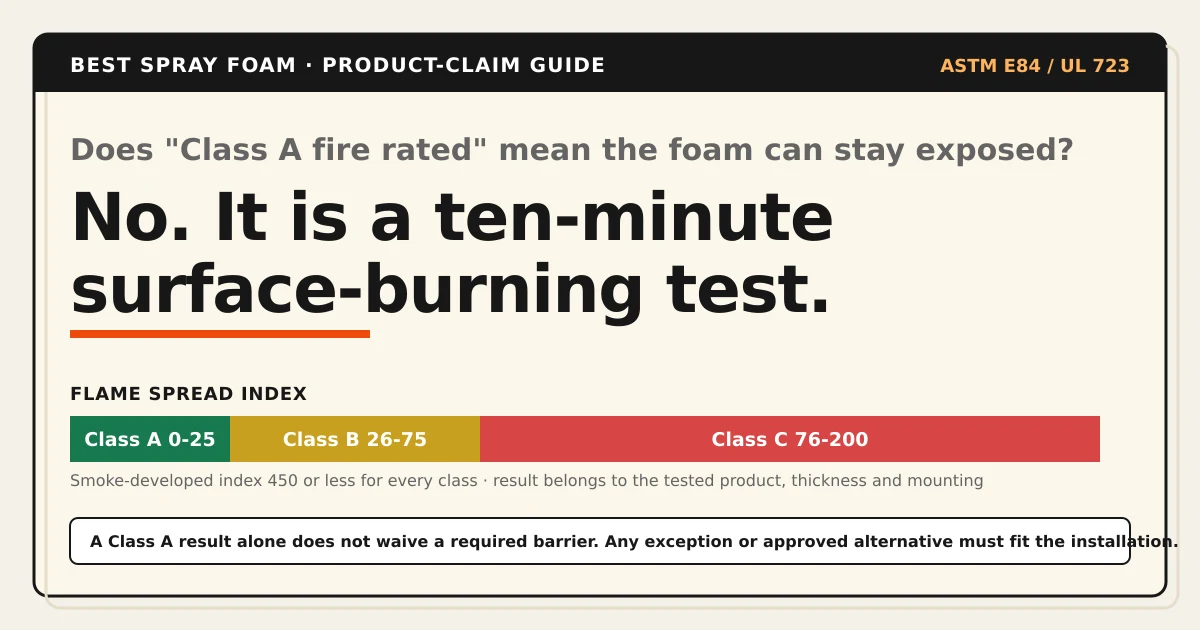
The short version. Class A means a flame spread index of 25 or less with a smoke-developed index of 450 or less in the ASTM E84 or UL 723 tunnel test. It does not make foam fireproof, and inside a house the default is still a thermal barrier over the foam. At the rim joist, the residential code lets spray foam go without that barrier only when the exact product documents all three of the following. Thickness of 3-1/4 inches or less, density of 0.5 to 2.0 pounds per cubic foot, and a Class A result under ASTM E84 or UL 723.
What the test can tell you
ASTM E84 measures how fast flame travels across the surface of a material and how much smoke it produces during a ten-minute exposure in a tunnel furnace. The specimen is about 24 feet long and 20 inches wide. It is mounted as the ceiling of the tunnel, a gas burner sits at one end, and air is drawn along the surface. Two numbers come out: a flame spread index (FSI) and a smoke-developed index (SDI). Both are scaled against select-grade red oak, which is set at 100 for flame spread.
These are comparative test indices. They are not a flame speed in feet per second, a mass of smoke, or a toxicity rating. The smoke index is built from how much the exhaust stream dims a beam of light, not from what the smoke contains.
UL 723 is UL’s separate standard for the same kind of surface-burning test. Building codes accept the two as alternatives, but a UL 723 report is not an E84 report under another name. A report should say which standard and which edition it used, because test details change between editions.
The specimen and its mounting matter. A result belongs to the material as tested: that formulation, that thickness, that substrate and mounting. It cannot automatically be extended to another configuration. That does not mean every installed thickness needs a new test. The code asks for testing at the maximum thickness intended for use. A thinner installation of the same product therefore sits within that test for the surface-burning requirement, while a thicker one does not without a further route. The report’s mounting, substrate and other stated limits still travel with the result at any thickness.
What Class A means
Class A means a flame spread index of 25 or less together with a smoke-developed index of 450 or less. The bands below come from the model code’s interior-finish classification (2021 International Fire Code, section 803.1.2), and the USDA Forest Products Laboratory describes the same bands in its Wood Handbook. They explain the terminology; they do not approve any foam for any building.
| Classification | Flame spread index | Smoke-developed index |
|---|---|---|
| Class A | 0 to 25 | 0 to 450 |
| Class B | 26 to 75 | 0 to 450 |
| Class C | 76 to 200 | 0 to 450 |
Read both indices. A product that clears the smoke cap but records a flame spread index of 40 is Class B, however the packaging is worded. A statement about flame spread without the smoke result is not the complete classification.
“Fire rated” on a can may refer to one of these surface-burning results, often Class A. The words prove nothing by themselves, and we have not sampled the market to say how the phrase is used across brands. Do not use the table to assign a class to an unidentified foam either. If no traceable evidence supports a seller’s claim, record the claim as unverified. Missing evidence is an information gap, not a failed test result and not a lower class.
The code floor for foam plastic is not Class A
The general floor in the model building code is not Class A. Section 2603.3 of the International Building Code sets it at a flame spread index of not more than 75 and a smoke-developed index of not more than 450. Application-specific provisions can be stricter and require 25 or less, so read the section that governs your assembly rather than the general floor alone. The test is ASTM E84 or UL 723, run at the maximum thickness intended for use. On flame spread that is Class B territory. The residential code carries parallel foam-plastic provisions in section R316.3, and the locally adopted edition and any amendments can tighten either.
A manufacturer that reports a flame spread index of 25 or less is therefore claiming more than the minimum. That is a meaningful signal, provided the number belongs to the product in the can and was produced at a thickness that covers the installation. One of the section’s exceptions shows how carefully thickness is treated. A product thicker than four inches may be tested at four inches, but only when its end use is approved separately under the large-scale test route described below.
Can Class A spray foam be left exposed?
Usually not. Two different questions hide inside “fire rated”. The tunnel test answers how a surface burns. Whether foam may stay uncovered is answered by the building code, and the default answer is a covering.
Fire resistance is a different test
An hourly fire-resistance rating describes a complete assembly under a different test, ASTM E119 or UL 263. UL Solutions describes the distinction plainly: the assembly test produces hourly ratings for compartmentation, while UL 723 produces the flame spread and smoke indices used against rapid surface fire spread. A short demonstration with a lighter establishes neither.
The default is a thermal barrier
Under the model code, foam plastic is separated from the interior of a building by a thermal barrier. Section 2603.4 names half-inch gypsum wallboard, heavy timber as the code defines it, or a material that passes both fire tests of NFPA 275. The exceptions sit in section 2603.4.1.
In attics and crawl spaces entered only to service utilities, section 2603.4.1.6 allows a lighter covering called an ignition barrier. The prescribed materials include 3/8-inch gypsum wallboard, 1/4-inch wood structural panel and 1-1/2 inches of mineral fiber, or another approved material installed so that the foam is not exposed. An ignition barrier still covers the foam. It is not a basis for leaving foam exposed. A proprietary coating is not named in that list; it can qualify only as an approved material, which in practice means an evaluation report or equivalent test evidence the building official accepts. The residential code carries parallel attic and crawl-space provisions within section R316.5.
Exposed foam runs through larger tests
Outside the prescriptive exceptions in section 2603.4.1, the route to exposed foam runs through larger tests, not through the tunnel. Section 2603.9 relieves foam plastic of the thermal barrier requirement, and of related sections that vary by edition, only where the exact product is specifically approved on the basis of large-scale tests. The 2024 text names four qualifying tests: NFPA 286 using the code’s acceptance criteria, FM 4880, UL 1040 and UL 1715. The finished assembly is tested at the maximum thickness intended for use, with seams and joints included. Where the foam serves as an interior finish under that approval, the interior-finish flame spread and smoke rules still apply.
Passing a test is the input. The approval belongs to the authority having jurisdiction. For spray-applied foam, ICC-ES AC377 is the acceptance criteria ICC-ES uses to tie a named product to those code sections, including any thermal or ignition barrier alternative; other evaluators apply comparable criteria. An evaluation report from ICC-ES, IAPMO UES or Intertek is the most complete single document a spray foam product can carry, because it names the product and states the conditions. It still documents only its stated scope.
None of this is a statement that a particular edition governs your project. Your adopted code, its amendments and the approved design are what govern. SFG’s thermal and ignition barrier guide explains the building-level distinctions.
The one place in the residential code where Class A changes the rules: the rim joist
At the rim joist, a Class A result is one of three conditions that let spray foam go without a thermal barrier. IRC section R316.5.11, as adopted, allows spray foam on sill plates and headers, or in the perimeter joist space, without the thermal barrier of R316.4 when all of the following are met:
- The foam is not more than 3-1/4 inches thick.
- Its density is between 0.5 and 2.0 pounds per cubic foot.
- It has a flame spread index of 25 or less and an accompanying smoke-developed index of 450 or less when tested per ASTM E84 or UL 723.
That third condition is a Class A result. So for a rim joist job, a verified Class A report is one of three documented facts that make exposed foam permissible under the model residential code. The other two are thickness and density, and they have to be documented for the same exact product. The exception relieves only the thermal barrier of R316.4. The general surface-burning rule of R316.3, which calls for testing at the maximum thickness intended for use, is not waived, so the tested thickness has to cover the installed thickness.
Two cautions. The adopted edition and local amendments govern, and the building official decides acceptance, so confirm the exception exists where you build. And most of the manufacturer documents in our product records state a Class A result at a two-inch test thickness without stating a density, which leaves the second condition unevidenced. One exception is worth naming: the Akfix ThermCoat data sheet publishes a specific gravity of 0.94 plus or minus 0.06 pounds per cubic foot under ASTM D1622, which falls inside the range the section requires. That is the manufacturer’s own figure for the cured foam rather than an as-installed density we have verified, and the same sheet carries a second fire line we have asked the manufacturer about. Until a product’s documents cover all three conditions and can be traced to the pack you are buying, we do not describe that product as meeting this exception, and neither should a listing. Our spray foam insulation kit research order shows where each product’s documents stand.
A real label example: the dimensions travel with the claim
The Great Stuff Wide Spray page states its fire claim as “Class-A Fire Rated up to 6” wide by 1” thick. Intertek Classified.” That is what a well-bounded claim looks like: a class, the application limits it applies to, and the name of a certifier a reader can check. We record what the manufacturer says; we have not independently checked the associated listing in this article.
The limits are the point. Removing the width and thickness would turn a specific claim into a broader one. The same caution applies to every brand, whether it sells a seam sealant, a surface-spray can or a two-component kit.
How to read a product’s fire report
Use this as a reading checklist, not a rule about how laboratories must format reports:
| Question | Evidence to look for | If it remains unresolved |
|---|---|---|
| Who issued it? | Issuer, report identifier and date | Verify through the issuing organization or a certifier’s public record |
| What material was evaluated? | Specimen identity and relevant formulation information | Obtain a traceable link to the sold product |
| What configuration was used? | Thickness, as-sprayed density, mounting, substrate and applicable limits | Do not extend the claim to another configuration |
| Which method and results? | Standard edition and both reported indices | Keep the classification claim unverified |
| What installed use is supported? | Relevant evaluation report, listing or accepted design conditions | Do not present the test as permission for the intended project |
A private-label name, marketplace ASIN or bundle identifier may be absent from a laboratory report. Supporting documentation can establish the relationship. A familiar logo or a matching color does not.
Request the full report and the supporting mapping, not just an isolated result page, and keep its limitations and appendices. If a certifier listing is claimed, look it up in the certifier’s public directory. Test laboratories do not usually publish report directories, so a bare report number is checked with the issuer, which is slower but still worth doing when the claim is central to your decision.
When the report and the can do not match
If report imagery looks different from the sold foam, note the discrepancy and ask the seller for an explanation tied to product identity. Color alone proves neither that the report is fraudulent nor that the foam is chemically identical. A document may refer to a manufacturing identifier rather than the retail name, but that connection still needs evidence.
An unresolved identity link has a narrow consequence: the result cannot yet be tied to that sold product. Keep the conclusion that small. Product identity, test performance and long-term durability are different questions with their own evidence.
A technical data sheet that repeats a Class A claim is manufacturer documentation, not the underlying laboratory report. A traceable laboratory report supports only its stated result and specimen scope. An evaluation report or certification has its own conditions; none of them is universal installation permission. In our product records we therefore separate the source type, the identity mapping and what remains unresolved, using the labels defined in our claim-status methodology. The same reading rule applies to every brand in the ranking, and no marketplace signal substitutes for the document.
What to do before relying on a fire claim
- Plan the covering before you plan the foam. Inside a house the default is a thermal barrier over foam plastic. Omitting it rests on an exception the adopted code names or on a product-specific approval; in a service-only attic or crawl space, a prescribed ignition barrier still covers the foam. Confirm with your building department.
- For a rim joist job, ask for three documented facts, not one: a Class A result, a tested thickness that covers your installation, and a stated density. A product that documents only the first has not documented the exception.
- Check the product name first. If the seller’s document does not carry the product name or a traceable mapping, treat the fire claim as unsupported and do not pay a premium for it.
- Prefer products with an evaluation report or a certifier listing. Those documents name the product and state the conditions, which is what a code official is likely to ask for.
- Keep fire, thermal and coverage claims separate. A strong flame spread number does not raise a product’s R-value at its stated thickness or its rated coverage and usable yield, and the FTC’s R-value Rule keeps thermal claims on their own evidence basis.
- Know the difference between Class A, fireblocking and a firestop. Fireblocking and firestopping are assembly functions with their own provisions; a surface-burning class is not a substitute for either.
Save the exact selected product, the relevant document version and any written identity clarification. When the evidence is incomplete, write down what is missing instead of assuming it. That is more useful than trusting a badge without its conditions, or assigning a lower class to a product nobody tested.
Questions buyers ask
Is Class A spray foam fireproof?
No. Class A is a surface-burning classification from a ten-minute tunnel test: a flame spread index of 25 or less and a smoke-developed index of 450 or less. It says the tested sample spread flame slowly compared with red oak. It is not an hourly fire-resistance rating, and the foam still burns.
What does fire rated spray foam mean?
On a can or listing it usually refers to a surface-burning result the manufacturer reports under ASTM E84 or UL 723, often Class A. The words prove nothing by themselves. Ask for the product name, the tested thickness, both indices and the laboratory or certifier behind them.
Are ASTM E84 and UL 723 the same standard?
No. They are separate surface-burning test standards that building codes accept as alternatives. A report should name the standard and the edition it used, and an E84 test report is not the same thing as a UL certification listing.
Can Class A spray foam be left exposed?
Usually not. The default is a thermal barrier between foam plastic and the interior. Omitting it rests on an exception the adopted code names, such as the rim-joist provision, or on a product-specific approval from a large-scale test such as NFPA 286. In a service-only attic or crawl space a prescribed ignition barrier may replace the thermal barrier, but it still covers the foam. Confirm with your building department.
Does rim joist spray foam need a thermal barrier?
Under IRC R316.5.11 as adopted, spray foam on sill plates and headers or in the perimeter joist space may omit the thermal barrier when the foam is not more than 3-1/4 inches thick, has a density of 0.5 to 2.0 pounds per cubic foot, and has a flame spread index of 25 or less with a smoke-developed index of 450 or less under ASTM E84 or UL 723. All three conditions must be documented for the exact product, and the locally adopted edition governs.
What is the difference between a thermal barrier and an ignition barrier?
A thermal barrier is the default covering over foam plastic inside a building, such as half-inch gypsum wallboard or a material that passes both NFPA 275 fire tests. An ignition barrier is a lighter covering the code allows only in attics and crawl spaces entered to service utilities, such as 3/8-inch gypsum wallboard or 1-1/2 inches of mineral fiber. Both cover the foam; neither is a fire rating of the foam itself.
Does a Class A rating tell me anything about R-value or coverage?
Nothing at all. Thermal resistance is measured by different tests under the FTC R-value Rule, and coverage is a yield figure the manufacturer states for given conditions. Each claim needs its own document.
Sources and scope
Accessed September 6, 2026. Manufacturer pages describe their own products; a source link is not our certification of its claims.
- ASTM E84-24, Standard Test Method for Surface Burning Characteristics of Building Materials · Public scope: nominal 24 ft by 20 in specimen, ten-minute exposure, flame spread and smoke-developed indices, red oak reference. Not a product approval.
- UL 723, Standard for Test for Surface Burning Characteristics of Building Materials, edition 11 (2018, revised June 23, 2025) · Separate surface-burning standard that codes accept as an alternative to ASTM E84.
- USDA Forest Products Laboratory, Wood Handbook FPL-GTR-282 (2021), chapter 18, Fire Safety of Wood Construction · Federal laboratory description of the tunnel test and the Class A, B and C flame spread bands with the 450 smoke cap used in building codes.
- ICC, 2021 International Fire Code, section 803.1.2, interior finish classification · Model-code source of the Class A, B and C index bands.
- International Building Code section 2603.3, Surface-burning characteristics (2024 text as adopted, on UpCodes) · Foam plastic insulation floor: flame spread index not more than 75 and smoke-developed index not more than 450 at the maximum thickness intended for use.
- International Building Code section 2603.4, Thermal barrier (adopted text on UpCodes) · General requirement to separate foam plastic from the interior with an approved thermal barrier; exceptions in 2603.4.1.
- International Building Code section 2603.4.1.6, Attics and crawl spaces (2024 text as adopted, on UpCodes) · Prescribed ignition-barrier coverings where entry is only for service of utilities.
- International Building Code section 2603.9, Special approval (2024 text as adopted, on UpCodes) · Large-scale test route: NFPA 286, FM 4880, UL 1040 or UL 1715 on the finished assembly at the maximum thickness intended for use; the sections relieved and the list wording differ between the 2018 and 2024 editions.
- International Residential Code section R316.5.11, Sill plates and headers (2021 text as adopted, on UpCodes) · Conditions under which spray foam on sill plates, headers or in the perimeter joist space may omit the thermal barrier.
- ICC-ES AC377, Acceptance Criteria for Spray-applied Foam Plastic Insulation (approved June 2023, editorially revised June 2024) · How an ICC-ES evaluation report ties a named spray foam product to code provisions, including barrier alternatives.
- NFPA 286, Standard Methods of Fire Tests for Evaluating Contribution of Wall and Ceiling Interior Finish to Room Fire Growth (NFPA standard page, current edition) · Room-corner test named in the special-approval route.
- NFPA 275, Standard Method of Fire Tests for the Evaluation of Thermal Barriers (NFPA standard page, current edition) · Test pair a non-gypsum thermal barrier must pass under section 2603.4.
- ASTM E119-24, Standard Test Methods for Fire Tests of Building Construction and Materials · The hourly fire-resistance test for assemblies, which E84 is not.
- UL Solutions, Safety in the built environment (accessed September 6, 2026) · Distinguishes UL 263 hourly assembly ratings from UL 723 surface-burning indices.
- Great Stuff Wide Spray product information (DuPont, accessed September 6, 2026) · Manufacturer example of a fire claim carrying width and thickness limits and a certifier name; not our verification of that listing.
- 16 CFR 460.20, R-value per inch claims (Cornell Legal Information Institute) · Why thermal claims are kept on their own evidence basis, separate from fire claims.