Source-based educational review. Independent technical review pending; this page does not approve an installation.
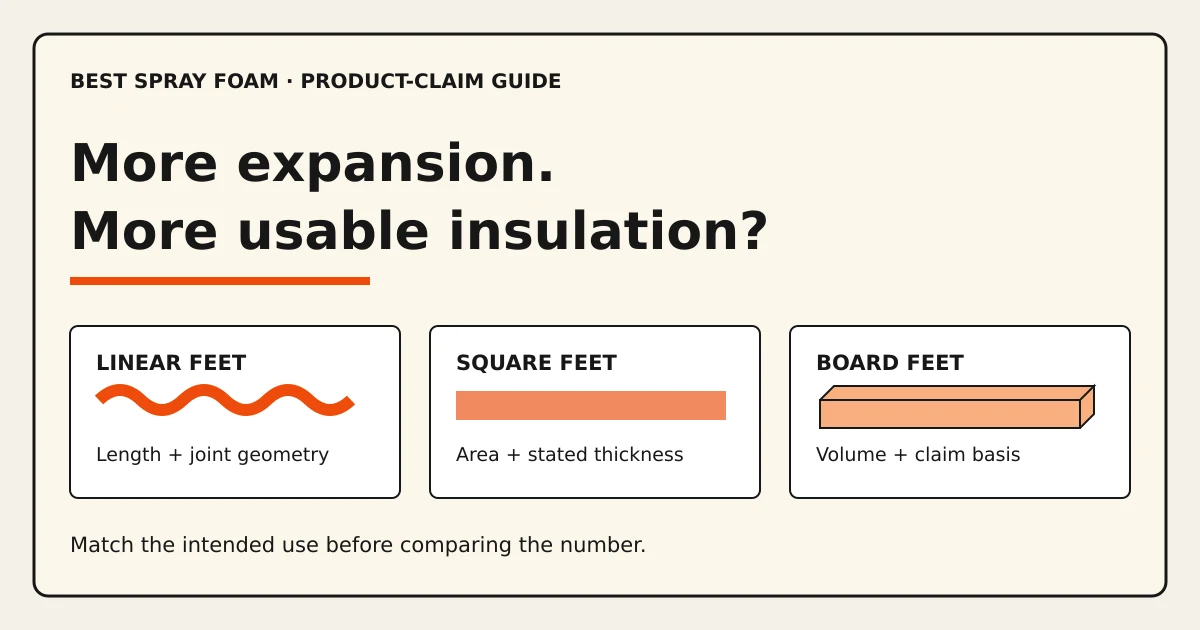
The short version. The two surface-spray cans we track are rated by their makers at up to 20 board feet per can at 1-inch thickness, under stated conditions. To estimate cans, multiply the area in square feet by the thickness in inches to get board feet, divide by 20, and add the 10 percent both makers suggest. What lands on your wall is at most the rated figure, and no label says how far below it you will land. Expansion, coverage and R-value are three different measurements, and of the three units a listing can use, only board feet builds thickness into the unit itself.
Does more expansion mean more coverage or a higher R-value?
Before reading a coverage number, write down what the job is: a joint around a pipe, a seam between materials, or an open surface that needs a continuous layer at a specified thickness. A big-looking bead may be doing its sealing job perfectly. It still does not tell you how many square feet of a different surface can be insulated.
Expansion describes a change in volume. Usable coverage describes an area completed at the required thickness under the maker’s conditions. R-value describes resistance to heat flow and is measured by a separate test. The Department of Energy’s insulation and air-sealing explanation describes insulation and air sealing as two separate improvements to the building shell, each with its own job.
A purchasing mistake begins when those three questions collapse into one impressive application video. You can see foam rise. You cannot see the finished thickness, the product identity, the temperature in the room or the long-term result.
What a board foot is and why kit labels use it
A board foot is 12 inches by 12 inches by 1 inch, or 144 cubic inches. It is a volume, which is why it works for insulation. One board foot covers one square foot at 1-inch thickness, half a square foot at 2 inches, and a third of a square foot at 3 inches. Multiply the area of your surface in square feet by the thickness you need in inches and you have the raw volume of the job in board feet.
Listings do not always use it. Three units show up, and they cannot be ranked by picking the biggest number.
| Listing unit | What must travel with it | What it does not establish |
|---|---|---|
| Linear feet | Bead or band width, plus the cured thickness | Square feet of a completed surface, or any board-foot figure |
| Square feet at a stated thickness | The thickness it was stated at, and the application conditions | Coverage at any other thickness |
| Board feet | Exact product, the conditions of the rating and the single-layer or multi-layer basis | The amount that will actually remain on the target surface |
How the makers state yield, in their own words
On a label, coverage is the area a can is rated to finish at a stated thickness, and yield is the volume of foam behind that area. Twenty square feet at 1 inch and 20 board feet are the same rating in two units. A manufacturer-rated yield is what the maker says a can can produce under its stated conditions. Field yield is what ends up on your surface at the thickness you need, and no label states it.
That difference is the subject of this guide. The table below records what four product lines from three makers publish in their technical data sheets (TDS) and on their product pages, with the conditions they attach.
| Product and document | Stated coverage or yield | Conditions attached by the maker |
|---|---|---|
| Kraken Bond FastCoat, TDS rev. 1, January 19, 2026 | Up to 20 board feet at 1-inch thickness | Single layer, sprayed from about 16 inches at normal speed; application at 41 to 86 F; recommended can temperature 68 F; net weight 27.1 oz |
| Kraken Bond FastCoat, product page | Up to 20 board feet per can | Recommends adding a 10 percent buffer to account for spray thickness variation |
| Sprayman SprayCoat, TDS | Up to 20 board feet at 1-inch thickness | One layer, from about 16 inches at normal speed; 12 to 18 inches from walls, 6 to 8 inches from ceilings; application at 41 to 86 F |
| Sprayman SprayCoat, product page | Covers up to 20 square feet at 1-inch thickness | Suggests adding 10 percent extra for uneven surfaces or waste; net weight 27.1 oz |
| Great Stuff Wide Spray, product page | Up to 60 linear feet at a 4-inch band per two-can kit | Two 18 oz cans; for seams, joints, large gaps and irregular surfaces up to 6 inches wide; expands up to 1 inch; FAQ: not approved for full cavity fill |
| DuPont Froth-Pak 200, product page | Approximately 200 square feet at 1-inch thickness | Theoretical yield, which the maker defines as calculated in laboratory conditions without accounting for blowing-agent loss or application variation |
Two rows are worth pausing on. SprayCoat’s retail page states the rating in square feet at 1 inch while its own data sheet states it in board feet. That is one rating in two units, and a reminder to read the unit before comparing numbers. The Wide Spray figure is a length, so it cannot be converted to board feet at all, because no cured thickness is attached to it. The page’s “expands up to 1 inch” is a maximum expansion, not a cured thickness tied to the 60-foot figure.
The SprayCoat documents also disagree with each other on can contents: the retail page says 27.1 oz, the data sheet’s packaging table says 28.7 oz. That is a product-identity question. The pack-matching guide tracks it. The printed yield figures do not change, but which of them applies to the can now sold is exactly what stays unresolved until the maker answers.
Why field yield can be lower than the label
Field yield can fall below the rated figure because the rating is a maximum under specific conditions, and no listing says how far below it will land on your job. The makers’ own documents name the variables. FastCoat’s data sheet says lower temperatures may reduce yield and lengthen cure, and that the quality and condition of the applicator gun can affect foam performance and yield. SprayCoat’s data sheet says lower temperatures decrease yield. Both rate the can in a single layer sprayed from about 16 inches at normal speed, so a slower pass, a closer nozzle or a second layer changes the basis.
Then there is what never lands on the target: overspray past edges, foam that fills around obstructions, and material trimmed flush after cure. SprayCoat’s page gestures at the same thing when it suggests extra for uneven surfaces or waste. None of it is a defect. It is the reason a rated 20 board feet is a ceiling rather than a promise.
Single-component listings rarely print a sentence like Froth-Pak’s definition of theoretical yield, which is why the gap between a rating and a finished wall goes unstated on the cans this guide tracks.
How many cans do I need? A worked estimate
Take an example job whose size is already settled: 120 square feet of open surface with a specified 2-inch layer. The thickness is an arithmetic input here, not an insulation recommendation for any wall or ceiling.
- Raw job volume. 120 square feet times 2 inches is 240 board feet. This number belongs to the job and does not change when you change brands.
- Claim-based can count. Using a product rated at 20 board feet per can, 240 divided by 20 is 12 cans. This is the count the label supports, and it assumes the rated conditions.
- Planning allowance. Applying the 10 percent buffer both tracked makers suggest gives 13.2 cans, so 14 whole cans, which is the same as 264 board feet of purchased foam divided by 20. The job itself stays 240 board feet. The allowance is a choice, not a measured loss.
Our spray foam calculator runs exactly this sequence: it reports the raw board feet of the job, then applies the 10 percent margin only to the can count when you leave that option on. Fourteen is the illustrative purchasing estimate under these assumptions, not a guaranteed sufficiency. Both tracked ratings are stated for a single 1-inch layer, and this example specifies 2 inches, so the application basis is not the one the rating was written for. The pack-matching guide covers that decision.
Two cautions travel with the arithmetic. It applies only after the product’s labeled use fits the surface; a seam sealant does not become a surface product because the division works. And it says nothing about the finished R-value, which is documented at a stated thickness on the product’s own evidence, as the R-value guide explains.
Gap filler vs. spray foam insulation: which one fits the job?
A foam sealant is not inherently low quality, and our foam sealant picks by job sort them that way. The confusion is created by the sellers’ own titles: twenty-one straw cans in our September 2026 intake carry “spray foam insulation” in the title while being sold by gap size, with no coverage area anywhere on the listing. The gap filler page names them and says it plainly: a can sold by gap size is a sealant, whatever the title says. Great Stuff Big Gap Filler, for example, is marketed by its maker for filling and insulating gaps up to 3 inches, around rim joists, sill plates and penetrations. That is a useful job with a stated limit. The purchasing question is whether the instructions cover your geometry and the performance you need.
A fan-shaped spray pattern does not answer that question either. Great Stuff Wide Spray is described by its maker as a sealant for seams, joints, large gaps and irregular surfaces up to 6 inches wide, expanding up to 1 inch. Its FAQ says it is not approved for full cavity fill. That is a documented application boundary, stated by the maker, and it is exactly the kind of sentence to look for before comparing any two cans. Our wide spray foam page records where each product in that group stands.
Do not turn a gap product into a surface-insulation product by changing its nozzle. Equally, do not assume every one-component can is only a gap filler; the FastCoat and SprayCoat documents describe surface application with wall and ceiling nozzles. Read the exact label and instructions. Our sister publication SprayFoamGuides explains the broader system distinction in its one-component versus two-component guide.
What an expansion demonstration leaves out
A video can show dispensing behavior under the conditions shown. It cannot, by itself, answer any of these questions:
- Was the final layer continuous at the specified thickness, including edges and around obstructions?
- How much material stayed on the intended surface, and how much was overspray or trimmed off?
- Which exact product, nozzle, can temperature and room temperature were used?
- Was the foam assessed after the cure period the maker states, or immediately after expansion?
Our guide to reviews and demos covers how we weigh videos, ads and owner accounts as evidence, and what a first-day clip can and cannot support.
What this means for a buyer
- Write the job in board feet first. Area in square feet times the thickness you need in inches. That number belongs to the job, not to any brand.
- Read the unit on the label. Linear feet need a band width and a thickness before they mean anything for a surface. Square feet need the thickness they were stated at. Board feet need the conditions of the rating.
- Treat the rated figure as a ceiling. Both tracked makers rate their cans at up to 20 board feet at 1 inch under stated conditions and suggest a 10 percent planning allowance. Neither publishes a field yield.
- Keep the allowance on the cans. Raw volume, then claim-based count, then allowance. Our spray foam calculator shows all three separately.
- Count insulation cans separately from cleaner, guns, nozzles and any finishing foam. A bonus sealant can be useful without adding to the main product’s rated yield.
- Check the labeled use before the arithmetic. A seam sealant’s coverage cannot be compared with a surface product’s, whatever the numbers say.
- Keep R-value on its own evidence. A bigger bead is not a higher R-value; the R-value guide explains what to compare instead.
For a record worth keeping, save the dated product page, the exact selected pack, the net contents, the source document and its stated yield basis. Leave unknown fields unknown. Those few facts are more useful than treating dramatic expansion as a coverage measurement. Where each tracked product’s documents currently stand is recorded in our ranked list of spray foam insulation kits.
Questions buyers ask
How many cans of spray foam do I need?
Multiply the area in square feet by the thickness in inches to get board feet, then divide by the can's rated board feet. For a product rated at 20 board feet, 120 square feet at 2 inches is 240 board feet, or 12 cans at the rating. Both tracked makers suggest adding 10 percent, which makes 14 whole cans. The rating assumes the maker's conditions.
How many board feet does a can of spray foam cover?
It depends on the product and its conditions. The technical data sheets for Kraken Bond FastCoat and Sprayman SprayCoat both state up to 20 board feet at 1-inch thickness in a single layer, sprayed from about 16 inches at normal speed. That is a manufacturer-rated figure under stated conditions, not a universal number for every can on the market and not a measured field result.
What is a board foot of spray foam?
A board foot is a volume: 12 inches by 12 inches by 1 inch, or 144 cubic inches. One board foot covers one square foot at 1-inch thickness, or half a square foot at 2 inches. Kit labels use it because it ties area and thickness together.
Does spray foam that expands more have a higher R-value?
No. Visible expansion is a change in volume. R-value is resistance to heat flow, measured by a different test at a documented thickness. Keep the exact product's R-value, its stated thickness and its test basis together, and do not infer any of them from foam height, color or a video.
What is the difference between gap filler and spray foam insulation?
The labeled use. An expanding foam sealant is documented for joints, gaps and openings of a stated size, and it can be genuine insulation and air sealing there. A surface-spray product is documented for covering an area at a thickness. Great Stuff Wide Spray, for example, is described by its maker as a seam and gap sealant and is not approved for full cavity fill.
Should I add 10 percent to my spray foam estimate?
The makers of both tracked surface-spray cans suggest it: the FastCoat page recommends a 10 percent buffer for thickness variation and the SprayCoat page suggests adding 10 percent extra. Treat it as a planning allowance on the number of cans you buy, not as a measured loss rate. Keep the raw board-foot figure for your job separate from the allowance.
Sources and scope
Accessed September 6, 2026. Manufacturer pages describe their own products; a source link is not our certification of its claims.
- Great Stuff Wide Spray product page (DuPont, accessed September 6, 2026) · Two 18 oz cans; up to 60 linear feet at a 4-inch band; for seams, joints, large gaps and irregular surfaces up to 6 inches wide; expands up to 1 inch; FAQ states it is not approved for full cavity fill.
- Great Stuff Big Gap Filler product page (DuPont, accessed September 6, 2026) · Foam sealant marketed for gaps up to 3 inches around rim joists, sill plates and penetrations; cited as an example of a legitimate gap product with a stated limit, not as a performance comparison.
- Kraken Bond FastCoat technical data sheet, rev. 1, January 19, 2026 · Net weight 27.1 oz; coverage up to 20 board feet at 1 inch in a single layer from about 16 inches at normal speed; application 41 to 86 F; notes that low temperature and gun quality and condition can affect yield.
- Kraken Bond FastCoat product page (accessed September 6, 2026) · Retail statement of up to 20 board feet per can and the maker's recommendation to add a 10 percent buffer for thickness variation; kit sizes from 1 to 192 cans.
- Sprayman SprayCoat Thermal and Sound Insulation technical data sheet · Yield up to 20 board feet at 1 inch in one layer from about 16 inches; spray distances 12 to 18 inches on walls and 6 to 8 inches on ceilings; packaging table lists 28.7 oz.
- Sprayman SprayCoat product page (accessed September 6, 2026) · Retail specifications: covers up to 20 square feet at 1-inch thickness, net weight 27.1 oz, and a suggestion to add 10 percent extra for uneven surfaces or waste.
- DuPont Froth-Pak 200 Foam Insulation and Sealant System product page (accessed September 6, 2026) · Two-component example: yields approximately 200 square feet at 1-inch thickness, with the maker's definition of theoretical yield as a laboratory figure.
- U.S. Department of Energy, Energy Efficient Home Improvement Credit: insulation and air sealing · Federal description of insulation and air sealing as two separate improvements to the building envelope; this guide makes no tax-credit claim.