Editorial source review. Examples explain our research method; they are not hands-on product tests.
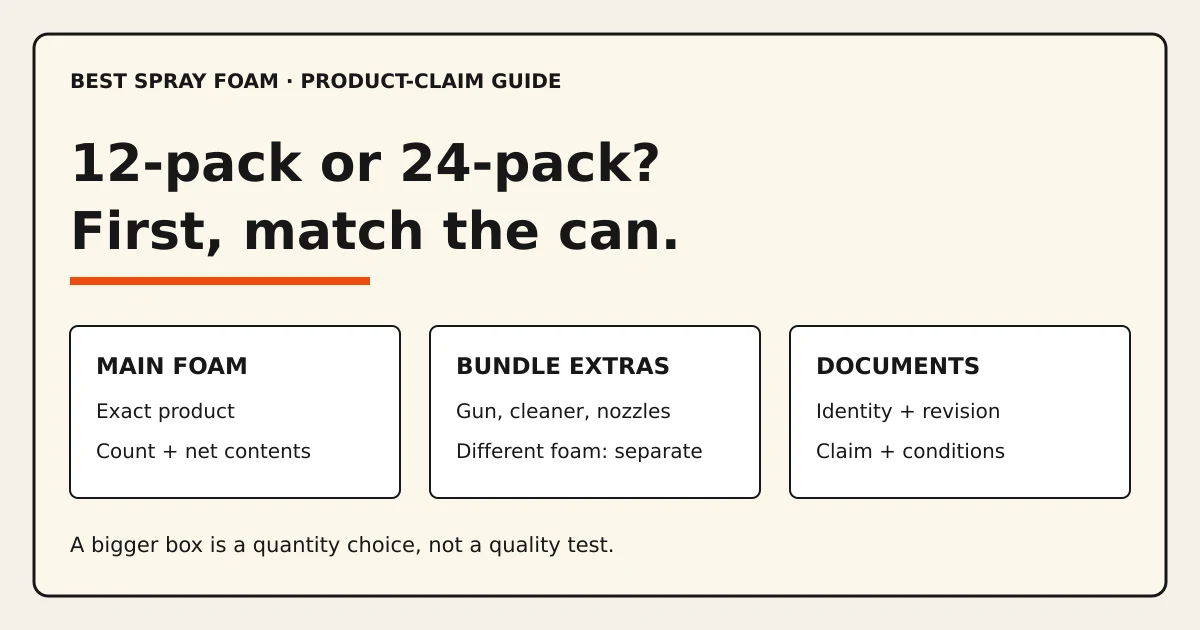
The short version. Match the can before you compare the box. A pack comparison is only fair when the main foam, the net contents per can and the maker’s document revision are the same on both sides. Any difference in accessories is then priced as its own line rather than ignored. A listing code identifies a listing, not a formulation. Work out the can count from the job first, then choose the pack combination that delivers it, and keep spare cans and bonus items as separate line items.
Match the can before comparing the box
An online bundle can contain several things described with the same word: kit. One seller counts only insulation cans. Another seller’s photograph includes a cleaner or a second foam. Before doing any price arithmetic, make a short inventory of what will arrive.
| Field | What to record | Why it changes the comparison |
|---|---|---|
| Main foam | Brand, exact name, model and any formulation identifier | Similar names and packaging do not establish the same material |
| Quantity | Number of main-product cans and net contents per can | An accessory can is not another insulation can |
| Bundle extras | Gun, nozzles, cleaner and any different foam product | A useful extra is still a different line item |
| Seller and selected option | Actual seller, the pack option you selected and the listing identifier | A general product-page link may open another option |
| Documents | Label, TDS, SDS, any relevant report and their revision dates | Evidence must be connected to the product being bought |
| Terms | Delivered cost, returns, storage and support route | A low headline price does not describe the full purchase |
This is our comparison worksheet, not a claim that every marketplace uses the same bundle conventions. Check the selected option again before ordering.
What a listing can and cannot tell you
A listing identifier names a listing, not a formulation. Amazon’s own explanation describes an ASIN as a unique 10-character alphanumeric code assigned to every product listed in its store. That explanation goes no further, and it does not describe how buying options are grouped on a product page. Treat the code as the record of the exact option you selected, then confirm that option in your order confirmation. It says nothing about whether the foam inside a 24-pack is the foam described in the document a seller links to.
The same is true of a brand’s own store. The FastCoat page offers can-only and kit variants in sizes of 1, 2, 6, 12, 18, 24, 48, 96 and 192 cans. Some options bundle a cleaner, such as 12 cans with a cleaner and 24 cans with two cleaners. A price is shown for the selected option. None of that changes the product’s technical documents, and none of it is evidence about them.
A real bundle example: main foam and finishing foam
On September 6, 2026, the FastCoat product page carried a notice reading “Same price. Better coverage.” attaching ThermaFoam Wide Spray to kits of 18 cans and up. We hold no dated price history to test the price half of that. FastCoat is described there as covering the main insulation areas, with the wide-spray product helping to finish corners, seams, and pipe and duct openings. That is a reason to examine the exact bundle, not to assume every seller includes it or that its output adds to FastCoat’s rated yield.
The two products should have separate rows in the basket. One row records the main insulation product and its claim. Another records the finishing foam and the jobs its own instructions permit. Confirm the actual quantity of each in the selected order. A campaign banner is not a packing list, and this one attaches the extra product to kits of 18 cans and up rather than to the 12-can options.
Likewise, included clothing or a mask does not establish that a kit supplies every exposure control your work requires. Use the exact safety data sheet, the instructions and your work plan. SFG explains ventilation and re-entry planning without treating bundle contents as safety approval.
What a manufacturer document can resolve
The FastCoat TDS is more useful for identity work than an unlabeled promotional image. Its product-information block carries a dated revision and the model number KR116PF01. It also states a net weight of 27.1 oz with 12 cans per box, an 18-month shelf life, and storage in a dry environment between 41 and 77 F. The model number is exactly the kind of identifier worth recording. It does not, by itself, complete the link to every 24-pack listing on every marketplace.
That packaging line also explains a count that can look like a mismatch: a 24-pack is two documented boxes, not a different product. Where a document describes a box while a retailer sells a multi-box kit, record the explanation and its source. Do not silently change the document to match the listing, and do not reject a sound document merely because it does not use a marketplace’s bundle name.
The same care applies to filename, model and product-name differences. A filename is a clue for locating a document, not the authority for its contents. Preserve the revision and the actual identifiers so the maker can confirm which sold units it covers.
An open question from our own research set
The SprayCoat retail page lists a net weight of 27.1 oz. The maker’s linked TDS packaging table shows 28.7 oz alongside a gross weight of 2.05 lb. These are different statements and need clarification before we call the pack-to-document mapping complete.
The discrepancy does not prove substitution, inferior foam or a false test. Our next question is narrow: which net contents and which document revision apply to the retail cans now sold? It stays open on this page until the maker answers it, and the claim-status methodology explains why an unresolved identity question is recorded rather than decided.
The same page shows a second thing worth recording. SprayCoat is sold on two axes: a type, either a set that includes a gun, cleaner and safety kit or a can-only option, and a pack size from a single can up to 192. A per-can comparison is therefore only meaningful within the same type, and a single-can set against a 24-can set compares two different baskets rather than 24 times one can.
Buying 14 cans: three ways to get there
Suppose the same documented main product is offered in several quantities, with identical net contents per can and the same rated yield basis. The coverage guide works an illustrative job to a claim-based count of 14 cans, including a 10 percent planning allowance. The pack decision starts there, not at the largest box.
| Combination | Cans delivered | Spare cans | What travels with it |
|---|---|---|---|
| One 12-pack plus one 2-pack | 14 | 0 | Two orders or two listings; check that both are the same product and revision |
| One 18-pack | 18 | 4 | At FastCoat, kits of 18 and up currently include a different finishing foam; record it as its own row |
| One 24-pack | 24 | 10 | One FastCoat 24-can option is listed as 24 Cans plus 2 Cleaners; spare cans have to sit within the maker’s shelf life and storage range |
That arithmetic still does not guarantee twice the completed area in two different installations. Neither the cheapest box nor the largest box automatically wins. Compare the available combinations, the compatible equipment, your storage conditions and the expected remainder. Two 12-packs and one 24-pack may supply equal main-can counts while including different accessories or terms.
Use the coverage guide to keep project volume separate from pack choice, and the calculator to get the count. Do not reduce a quoted R-value to a new per-inch claim as part of the comparison; the R-value guide has its own evidence rules.
Price snapshots stay attached to a date
The FTC’s online shopping guidance tells buyers to learn the total cost of a product, including shipping, handling, delivery, taxes and other fees. It also says to read the terms of an advertised deal and to check the seller’s refund policy before buying. Our worksheet therefore uses the actual eligible basket, delivered, not a crossed-out reference price or an assumed coupon.
A discount can make an appropriate product better value. It does not tell you why the seller changed the price, how much it sells or how well it performs. Without a dated price history and matched packs, we cannot responsibly write that one brand undercut another by a fixed amount, or that a price moved because demand changed.
Where we do publish prices on a product record, they are a dated snapshot of one day’s ladder, never a price history and never a prediction. The useful part is not the number, it is the arithmetic beside it: cost per can at each size, and the premium a kit adds over the same foam bought on its own. Keep your own note of the date, the seller, the shipping terms and the selected option, because the number will have moved by the time you read it again.
That arithmetic regularly contradicts the assumption that a bigger box is cheaper. On the BEEST FullStop record the 24-can kit worked out dearer per can than the 18-can kit on the day we recorded it.
What this means for a buyer
- Get the can count from the job, not from the box. Board feet of the job, divided by the maker’s rated yield, plus any allowance on the count. Then pick the pack combination.
- Match four things before comparing two packs: the exact product name, the net contents per can, the accessories in the box, and the document revision the seller links to.
- Treat a listing code as a filing label. It tells you which option you selected. It does not tell you what is in the can.
- Give every different product its own row. A finishing foam, a cleaner or a gun can be worth having. None of it adds to the main product’s rated yield.
- Keep spare cans honest. FastCoat’s data sheet gives an 18-month shelf life and storage between 41 and 77 F in a dry environment, so check the equivalent lines before paying for ten cans you will not use this season.
- Keep the record small and dated. Selected option, packing list, photos of delivered labels, and the document URLs and revisions you relied on. Remove addresses and order numbers before sharing it.
If something differs between the document and the box, ask for an explanation before transferring performance claims from a different package. The objective is not to punish a brand for a naming change. It is to make sure the evidence follows the foam in the box. Where each tracked product’s documents stand today is recorded in our spray foam insulation kit research order.
Questions buyers ask
Is a 24-pack of spray foam the same product as the 12-pack?
Often, but the box does not prove it. Check that the can label, the net contents and the maker's document revision match across both packs, and list what else is in each box. On the FastCoat page, for example, a notice attaches a different finishing foam to kits of 18 cans and up, and one of the 24-can options is listed as 24 Cans plus 2 Cleaners.
Does a different ASIN mean the foam formulation changed?
Not necessarily. Amazon describes an ASIN as a unique 10-character alphanumeric code assigned to every product listed in its store. The code identifies a listing, not a formulation. Match the physical product identity, the maker's documents and the selected pack, and confirm the option in your order confirmation.
Can the same TDS cover both a 12-pack and a 24-pack?
It can, if the cans contain the same documented product. Packaging arithmetic is not the evidence of that identity. Check the can label, the model or formulation mapping and any change in net contents between the two packs.
Should a bonus sealant count as extra insulation yield?
No. Keep different products separate. A finishing sealant may be useful at seams and openings, but its claim cannot be added to the main product's board-foot total, and its own documents govern where it may be used.
Does a document mismatch prove a fake product?
No. A mismatch needs a traceable explanation. It can reflect different packs, older documentation or an unresolved identity question. It does not establish fraud, substitution or a failed product, and it does not establish that the product is fine either.
How many cans of spray foam should I buy for my job?
Start from the job's board feet, which is area times thickness, divide by the maker's rated yield per can, then apply any planning allowance to the can count. Our calculator does this and the coverage guide explains the units. Then choose the pack combination that delivers that count, and treat spare cans and included accessories as separate line items.
Sources and scope
Accessed September 6, 2026. Manufacturer pages describe their own products; a source link is not our certification of its claims.
- Kraken Bond FastCoat product page (accessed September 6, 2026) · Kit options from 1 to 192 cans, can-only and kit variants, cleaner bundles, and the notice that kits of 18 cans and up include ThermaFoam Wide Spray at the same price.
- Kraken Bond FastCoat technical data sheet, rev. 1, January 19, 2026 · Dated revision, model number KR116PF01, packaging line of net weight 27.1 oz and 12 cans per box, 18-month shelf life and 41 to 77 F storage; not proof of every marketplace variant.
- Sprayman SprayCoat product page (accessed September 6, 2026) · Retail net weight 27.1 oz; two purchase axes, a set that includes a gun, cleaner and safety kit or a can-only option, each from a single can up to 192; link to the maker's TDS.
- Sprayman SprayCoat Thermal and Sound Insulation technical data sheet · Packaging table lists 28.7 oz and a gross weight of 2.05 lb, which needs reconciling with the retail page.
- Amazon, What is an ASIN (Sell on Amazon blog, accessed September 6, 2026) · Amazon's own definition: a unique 10-character alphanumeric code assigned to every product listed in the Amazon store.
- FTC, Online Shopping (consumer guidance, accessed September 6, 2026) · Learn the total cost including shipping, handling, taxes and fees; read the terms of an advertised deal; check the seller's refund policy.