Editorial source review. Examples explain our research method; they are not hands-on product tests.
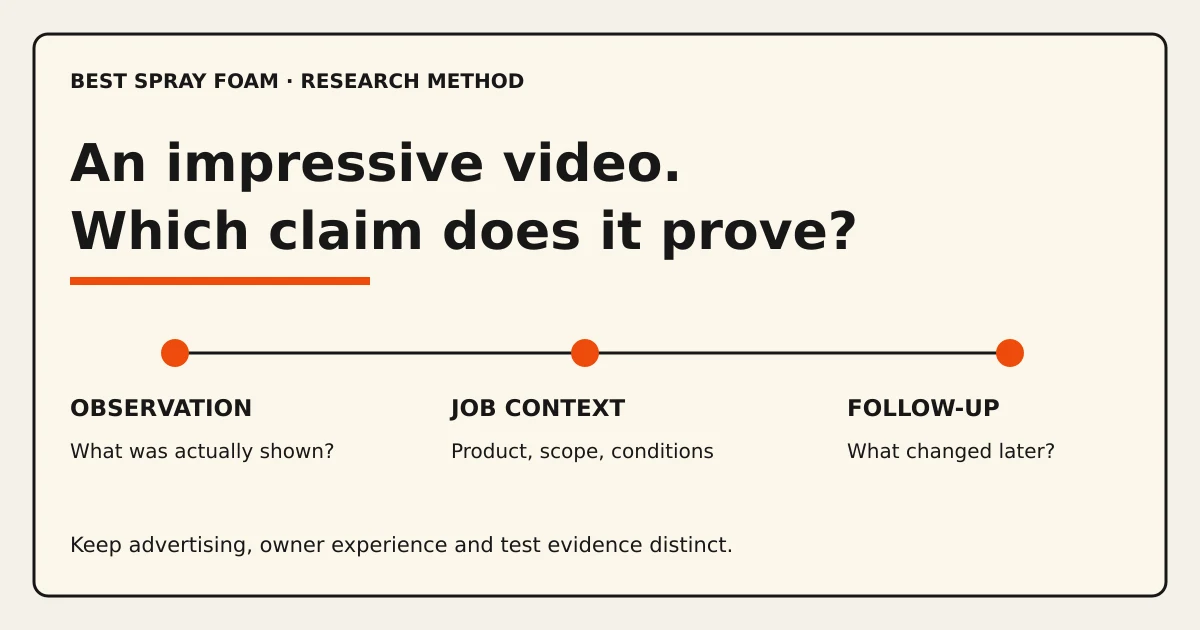
The short version. A review is evidence of what one person observed, on one job, at one point in time, and only if it says which product, which job and when. A platform badge confirms a transaction, not a result. An ad or a maker’s demo is a lead to a claim, not the evidence for it. And since October 21, 2024, a federal rule has made it unlawful for a business to create or buy fake reviews, or to pay for a particular sentiment. The same rule bars claiming that displayed reviews are most or all of those submitted while others are suppressed by sentiment. That changes what a burst of five-star reviews can mean. It does not turn any review into a test.
Start by asking what the reviewer actually observed
“The box arrived,” “the foam expanded,” “the wall was finished,” and “the installation was still fine after two winters” are four different observations. Each can be useful. None should be silently upgraded into another.
We read a review against its exact product, pack, project and observation date. If those are absent, the account may still identify a support question, but it is weak evidence for comparing completed insulation performance. A report of poor yield without area or thickness does not tell us how far the can should have gone.
The FTC’s consumer guidance on reviews recommends looking at a variety of sources and checking how recent the reviews are. It also says to watch for a burst of reviews over a short period, and to read a reviewer’s other reviews to judge how much to trust them. Our foam-specific questions below are editorial method, not a claim that we have already audited a representative review sample for each ranked product.
What each source can contribute, and where it stops
| Source | Potentially useful evidence | Limit we keep visible |
|---|---|---|
| Manufacturer demonstration | Product setup and behavior shown in that demonstration | Brand-produced material is not an independent trial |
| Disclosed sponsored creator | A specific user’s account and visible conditions | Compensation or supplied product remains relevant context |
| Owner review | Reported job experience, support or packaging issue | Identity, conditions and outcome may be incomplete |
| Platform badge | A transaction check under the platform’s rules | Says nothing about thickness, yield, cure or durability |
| Star rating | A model-weighted summary of ratings the platform accepted | Not a measurement, and the weighting is the platform’s |
| Maker’s document | Rated figures with their stated conditions | The maker’s statement, not an independent result |
| Test report | Results within its identified specimen and method | Does not establish every installation or every claim |
| Dated follow-up | Changes observed in an identified installation | One job is not a category-wide reliability study |
Brand-produced videos can help a reader understand a nozzle or a kit layout. They do not replace field testing, and we do not describe video research as hands-on testing. We also do not label an unconfirmed creator relationship independent.
What the platform badge and the star rating actually mean
A Verified Purchase badge confirms a transaction under the platform’s rules; it does not confirm a result. Amazon’s customer help page says it checks whether the reviewer bought or used the item on Amazon and paid a price available to most shoppers, and labels the review Verified Purchase when it confirms both. The same page says reviews without the label can also be helpful, for example when a customer bought the item elsewhere.
The star rating is a second kind of summary. Amazon says it calculates a product’s star rating with machine-learned models rather than a simple average, weighing factors such as how recent a review is and its verified status. That is useful to know when reading a 4.6 next to a 4.4: the number is a platform’s weighted output, and the platform decides the weights. It is not a measurement of the foam.
More expansion is an observation, not a verdict
An expanding bead may look impressive and satisfy a reviewer whose task was filling a permitted gap. A different reader may need a continuous insulation layer. Moving the review from the first task to the second changes the question it can answer.
The coverage guide explains why finished thickness, units and intended use matter. In a video assessment, record what is actually visible: the labeled product, the surface, the nozzle, the time sequence and any documented measurement. Mark missing conditions as missing. Do not infer an R-value from foam height, or a defect rate from the texture in a close-up.
Color is not a laboratory identification method either. A mismatch between a sold product’s description and report imagery warrants clarification of identity and formulation. By itself it does not establish that a report is inauthentic or mismatched to the product, and a similar color does not prove that two foams are the same. The fire-rating guide shows how we handle that question for a Class A claim.
Advertising is a lead to a claim, not the evidence for it
Repeated ads can introduce a product worth investigating. They cannot establish category leadership, measured yield or durability. A popular product might be good; a little-known product might be good. The research question is what supports the claim for the exact sold product.
When a creator is paid or receives a product, the relationship can affect how readers weigh the endorsement. The FTC’s Endorsement Guides, at 16 CFR 255.5, cover connections the audience would not reasonably expect. Where such a connection might materially affect the weight or credibility of an endorsement, it must be disclosed clearly and conspicuously. The Guides name business, family and personal relationships, payment, and free or discounted products as examples. They are the Commission’s interpretation of Section 5 rather than a separate rule, but conduct inconsistent with them can support a deception claim. The FTC’s questions and answers explain it in plain language. Disclosed sponsorship does not make every observation false. It means the relationship stays visible while the evidence is evaluated.
We do not infer country of manufacture from a brand name, packaging or appearance, and even a verified manufacturing location is not a substitute for performance evidence. Questions about imitation, demand manipulation or sales leadership are separate factual matters that require records. An advertisement is not evidence of any of them.
What federal rules now say about reviews
Since October 21, 2024, the FTC’s Rule on the Use of Consumer Reviews and Testimonials has made specific review practices unlawful. The rule is codified at 16 CFR Part 465, was published in the Federal Register on August 22, 2024, and took effect 60 days later, as the FTC’s announcement stated. Four sections matter most for reading spray foam reviews.
- Fake or false reviews (465.2). A business may not write, create or sell a review that materially misrepresents that the reviewer exists, used the product, or had the experience described. It may not buy one where it knew or should have known the same. A parallel bar covers reviews it procures from its officers, managers, employees or agents, or their immediate relatives, for posting on a third-party platform, with exceptions for generalized solicitations and for merely hosting reviews.
- Bought sentiment (465.4). A business may not provide compensation or other incentives in exchange for, or conditioned on, reviews expressing a particular sentiment, whether positive or negative.
- Company-controlled review sites (465.6). A business may not materially misrepresent that a website, organization or entity it controls, owns or operates provides independent reviews or opinions about a category of businesses or products that includes its own. The section excludes consumer reviews from that prohibition.
- Review suppression (465.7). No one may use unfounded legal threats, intimidation or knowingly false accusations to prevent or remove a review. A business also may not materially misrepresent that the reviews it displays are most or all of those submitted while suppressing others by rating or negative sentiment. Criteria applied equally to every review regardless of sentiment are not suppression under this section, such as removing defamatory or obscene content, personal information, or content that is clearly false or misleading.
What this changes for a reader is narrow but real. A burst of enthusiastic reviews is still a reason to look closer, as the FTC’s consumer guidance says, but a business that manufactured the burst is now breaking a rule, not just a norm. A page of only good reviews can no longer be presented as most or all of what was submitted if negative ones are being suppressed by sentiment. None of this makes any individual review more accurate. It changes what a pattern may mean, and it gives an aggrieved reader somewhere to report. The FTC’s rule questions and answers cover the details. This guide is not legal advice.
Our sampling rules before publishing a review-based conclusion
For any future sampled comparison, the research record must include the eight fields below. The figure that follows is the same record as a blank card, with today’s status stamped on it.
- Exact product and variant, platform and access date.
- The review period, the inclusion rule and how records were selected.
- The number examined, the number excluded and the reasons for exclusion.
- Any transaction badge or disclosed incentive, without treating either as technical validation.
- Separate themes for shipping, equipment, application, coverage, support and later observations.
- Missing thickness, area, conditions and time since installation, recorded as missing.
- Duplicate or cross-posted accounts, so the same experience is not counted twice.
- Both favorable and unfavorable findings under the same criteria.
These are requirements for a defensible published analysis. Until a product’s sample is actually recorded, we do not publish a precise satisfaction percentage, a “most reliable” finding or a quality score derived from reviews. Selecting only the most enthusiastic or the most alarming examples would not answer the comparison fairly.
Look for evidence beyond the first day
A first-day review has no multi-year observation period. But the absence of long-term evidence is also not proof that a product will fail on a particular timetable. We do not convert unfamiliarity with a formulation into a forecast of damage.
Useful follow-up identifies the original product and installation, the observation interval, what was inspected and any intervening leak, repair or exposure. Even then, it describes those observed conditions. A pattern needs more than isolated anecdotes, and it must separate material issues from installation and building conditions.
Where an owner reports a current problem, SFG’s problem library explains documentation and escalation boundaries. A review article cannot diagnose hidden foam or authorize continued occupancy.
Apply the same scrutiny to this publication
Our current product order is provisional research, not a completed laboratory ranking. A position in that order does not verify a fire report, establish a field-yield measurement or certify suitability for a project. See the methodology and each product’s visible evidence status.
Section 465.6 of the review rule reaches a business that materially misrepresents a site it controls, owns or operates. The misrepresentation it names is presenting that site as a source of independent reviews or opinions about a category of products that includes its own. Consumer reviews are excluded from that prohibition, which leaves editorial opinion squarely inside it. The same 16 CFR 255.5 disclosure standard we apply to creators applies to us, and it applies now rather than at the point some future recommendation is published.
So here is the state of our own disclosure, stated plainly rather than implied. SprayFoamGuides is our sister publication under common ownership, and it is not an independent endorsement of anything we publish. Our ownership and conflicts page states those connections, and says plainly that no money changes hands with any brand here today and that an Amazon affiliate relationship will be disclosed the day it starts. Read the product order as provisional research from a publisher whose connections you can inspect. Weigh it on that basis, and rely on the linked source documents rather than on our ordering. This guide is not legal advice.
What this means for a buyer
- Read for the four facts first: which product and pack, which job, what was observed, and when. A review without them is a support question, not performance evidence.
- Treat badges and stars as platform summaries. A Verified Purchase label confirms a transaction. A star rating is a weighted output whose weights the platform chooses.
- Weigh disclosed sponsorship, do not dismiss it. The disclosure tells you the relationship exists; the observations still have to be checked on their own terms.
- Look closer at bursts and at pages with no criticism. The FTC’s consumer guidance flags the first. For the second, the review rule makes it unlawful to present displayed reviews as most or all of those submitted while others are suppressed for their rating or sentiment, so it is worth a question.
- Keep first-day clips in their lane. They show dispensing behavior under the conditions shown, nothing more; the coverage guide explains what they leave out.
- Ask what documents exist. A maker’s data sheet with conditions, or a report tied to the exact product, sits higher on the ladder than any number of reviews. The pack-matching guide shows how to connect one to the box you are buying.
The standard is simple to inspect: show what was observed, link what was documented, state what remains unresolved, and do not let either a positive ad or a negative accusation fill the gaps.
Questions buyers ask
Does a verified-purchase badge prove a performance claim?
No. Amazon says it applies the Verified Purchase label when it confirms the reviewer bought or used the item on Amazon and paid a price available to most shoppers. That is a transaction check under the platform's rules. It is not independent verification of thickness, yield, cure, durability or code suitability.
Are fake spray foam reviews illegal?
Since October 21, 2024, the FTC's Rule on the Use of Consumer Reviews and Testimonials, 16 CFR Part 465, has made it unlawful for a business to write, create or sell reviews that materially misrepresent the reviewer's existence or experience, to buy such reviews where it knew or should have known, to pay for reviews expressing a particular sentiment, or to present displayed reviews as most or all of those submitted while suppressing others by rating or sentiment. This guide is not legal advice.
Do sponsored spray foam videos have to say they are sponsored?
Under the FTC's Endorsement Guides, 16 CFR 255.5, a connection between an endorser and a seller that might affect the weight of the endorsement, such as payment or free product, must be disclosed clearly and conspicuously when the audience would not expect it. The Guides are the Commission's interpretation of Section 5 rather than a separate rule, but conduct inconsistent with them can support a deception claim. A disclosure does not make the observations false. It tells you how to weigh them. This guide is not legal advice.
Does aggressive advertising mean a foam is bad?
No. Advertising reach and product performance are different questions. We examine the exact claim and its evidence instead of inferring quality from ad frequency or spending.
Can a first-day video show that foam will last for years?
No. It records an early observation. A long-term statement needs relevant follow-up evidence on an identified installation. An immediate good appearance neither proves durability nor predicts failure.
Do negative reviews establish a brand's failure rate?
Not without a suitable denominator, a defined sample and comparable conditions. Voluntary reviews can identify questions worth investigating, but a share of negative reviews is not a failure rate among sold products.
Sources and scope
Accessed September 6, 2026. Manufacturer pages describe their own products; a source link is not our certification of its claims.
- FTC, How to Evaluate Online Reviews (consumer guidance, accessed September 6, 2026) · Look at a variety of sources; check how recent reviews are and watch for bursts over a short period; check whether the reviewer has written other reviews.
- 16 CFR Part 465, Rule on the Use of Consumer Reviews and Testimonials (Cornell Legal Information Institute) · Final rule published at 89 FR 68077 on August 22, 2024; sections 465.2, 465.4, 465.6 and 465.7 are summarized in this guide.
- FTC press release, Federal Trade Commission Announces Final Rule Banning Fake Reviews and Testimonials (August 14, 2024) · States that the rule takes effect 60 days after Federal Register publication.
- 16 CFR 255.5, Disclosure of material connections (Cornell Legal Information Institute) · When a connection between an endorser and a seller might affect the weight of an endorsement and the audience would not expect it, it must be disclosed clearly and conspicuously.
- FTC, Endorsement Guides: What People Are Asking (business guidance) · Plain-language questions and answers on material connections and disclosures; not a finding against any foam brand.
- FTC, Consumer Reviews and Testimonials Rule: Questions and Answers (business guidance) · Review integrity and company-controlled review sites; this guide is not legal advice.
- Amazon customer help, reviews and the Verified Purchase label (accessed September 6, 2026) · Amazon labels a review Verified Purchase when it confirms the reviewer bought or used the item on Amazon and paid a price available to most shoppers; star ratings come from models that weigh recency and verified status.